  
  
|
 |
|
|
|
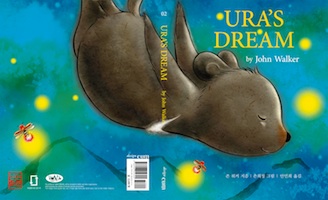 John Walker- the chairman of Macquarie group of Korea has published his second children's book, with a young moon bear-Ura" - as its central character.
This follows the first book -Ura's World- which introduced us to the new born Ura and his two feathered friends-Gaachi, the young Korean magpie, and the bespectacled and wise old eagle ,Doc Suri.
John Walker- the chairman of Macquarie group of Korea has published his second children's book, with a young moon bear-Ura" - as its central character.
This follows the first book -Ura's World- which introduced us to the new born Ura and his two feathered friends-Gaachi, the young Korean magpie, and the bespectacled and wise old eagle ,Doc Suri.
Whilst Ura's World was set in summer Ura's Dream takes place in winter when bears in the wild actually hibernate. Ura's latest adventures then are actually dreams he has throughout the long winter.These dreams include dancing with fireflies, visiting a family of tigers far in the north and eating berry ice cream with a red fox.
As always Ura is a little clumsy and accident prone and we are reminded of the great singing and dancing talents of the baby moon bear.
Order your copy today!
(Continued)
 moonbears.org presents the beautifully illustrated book Ura's World by John Walker. 'Ura's world' tells a tale about a young, spirited, mischievous little moon bear named Ura and his charismatic gang of forest friends in their mountain environment, far from the city. Among these friends are the wise old eagle "Doc Suri", a spectacle-wearing creature with an interesting history. We read about Doc Suri's first encounter with a Human and learn a thing or two about the value of helping others. We meet the bright bird "Gaachi", who later comes to Ura's rescue as young Ura finds trouble as easily as he finds fun. The story ends with another encounter with the human world, and Ura and friends learn a lesson about the manner in which life holds a delicate balance of action and consequence.
Order your copy today!
A BRUTAL TRADE IN A PROTECTED SPECIES THAT YOU WON’T SEE MENTIONED AT FTA NEGOTIATIONS
Is Korea a modern industrial and technological powerhouse, as its government would have the world believe? Or is it still a developing country steeped in superstition, struggling to shake off the vestiges of its third-world past?
 Korea has been at pains in recent years to prove itself as a major actor on the world stage. It is attempting to improve its access to world trade by ratifying a free trade agreement with the US and other countries.
In conjunction with these status-enhancers, Korea’s environment department recently declared part of Antarctica an Endangered Species Protection Zone and trumpeted this as another example of Korea’s environmental credentials and proof of its responsible citizenship as a regional power.
This same Department is responsible for regulating more than 60 bear farms around Korea which produce gall bladders for oriental medicine. They form part of a secretive but lucrative trade within Korea of an animal, which is protected from such exploitation by an international convention – TO WHICH KOREA IS SIGNATORY! The hypocrisy is breathtaking.
Instead, Korea is being shown up embarrassingly by supposedly less advanced nations. China is currently monitoring bear farms in response to international outrage. In 2005, Vietnam declared a total ban on bear farming and is creating bear sanctuaries for former farm bears.
 In Korea, in the same year as Vietnam ban, the government announced a policy of allowing the slaughter of bears for their gall bladders from age 10 onwards. Also, activists claim that Korean regulators are not inspecting farms, which are illegally draining bile from live bears.
All this may not come up in FTA discussions, but perhaps it should. Many of the bears in these so-called farms – in some cases little more than cages hidden in suburban homes – came from North America.
The Korean government, though it created this industry, has refused to address the existence of these farms – instead actually condoning their operation. This indicates yet again the power of Korea’s farming lobby – which vociferously opposes any FTA involving agricultural concessions – to disproportionately influence Korea’s attempts to enter the global community as a responsible and enlightened actor.
Korea has a conflicted relationship with the bear. Despite the brutal treatment meted out to bears in modern-day Korea, the bear has a special place in Korean history.
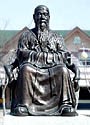 Legend has it that Hwan-ung, the son of Hwan-in (who was the God of All and the ruler of Heaven), yearned to live on Earth. His father sent him and 3,000 helpers to rule Earth and provide humans with great happiness. Hwan-ung descended to Mount T'aebaeksan on the border between Manchuria and what is now North Korea. He named the place Shinshi, City of God. Along with his ministers of clouds, rain, and wind, he instituted laws and moral codes and taught the humans various arts, medicine, and agriculture.
A tiger and a bear living in a cave together prayed to become human. Upon hearing their prayers, Hwan-ung called them to him and gave them 20 cloves of garlic and a bunch of mugwort. He said they should only eat this sacred food and remain out of the sunlight for 100 days. The tiger gave up and left the cave. However, the bear remained true and after 21 days was transformed into a woman.
The bear-woman was very grateful and made offerings to Hwan-ung. However, lacking a companion she soon became sad and prayed for a child. Hwan-ung took her for his wife and soon she gave birth to a handsome son. They named him Tan-gun, meaning "Altar Prince" or sandalwood. He became Korea’s first king.
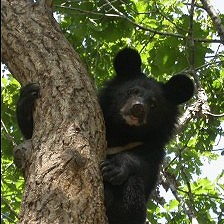
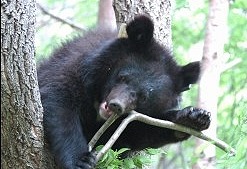 The Korean Moon Bear, also known as the Asiatic Black Bear, has a diet consisting chiefly of fruits and vegetables, honey, and insects. They are regarded as being of no danger to humans unless threatened. Their lifespan in the wild is 20 to 40 years. They are an endangered species and in 1982 were declared by the Korean Govt as protected species number 329, Cataogoty1 under CITES. Category 1 means Legislaton which meets all the requirements for implementing CITES.
There are only known to be 16 moon bears in the wild at Jiri Mountain. These were released at this location by the Government for their protection as endangered species. But poaching is already prevalent in this area. In fact a recent report on SBS television showed over 100 traps being discovered in just over 90 minutes in that area.
In contrast to the pitifully low numbers of bears in the wild, there are currently 1,140 bears at around 60 Korean bear farms most of which treat the bears with extreme cruelty.
1981 - Just one year before the declaration of Moon Bears as a protected species, the Korean Agriculture Department imported 493 bears - mostly Asia for breeding and export.
1985 - The import of bears was then banned only four years after the same Govt officials began importing the bears. The main reason for this is that other countries began banning bear imports, making Korea look bad. Bear farmers were allowed to slaughter bears for oriental medicine as compensation for import ban and the decline of the legitimate live bear export market.
Government policy changed dramatically from farming to breed towards farming for slaughter. Still, the regulation does not allow for the draining of bile from live bears though this practice is believed to be widespread and not policed.
1993 - The Korean Govt joined CITES [Convention of International Trade in Endangered Species of Fauna and Flora], which outlaws the sale of bear gall bladder.
1999 - The Environment Department takes responsibility for bear farms from the Agriculture Dept.
2005 – Another policy change, this time under pressure from community groups. The Bear Farm Administration Index is introduced, providing guidelines for the proper handing of bears in captivity.
2008- The maximum age for slaughter of bears is reduced from 24 years old to just 10 years old. The Environment Department does not monitor bear farms to ensure these guidelines are being followed.
Moreover, the department does not keep a record of the actual number of bears now being held in the farms. There are no regulations providing for any specific method of slaughter, and there is a widespread belief that the bears are killed inhumanely. All of these conditions are against CITES agreement.
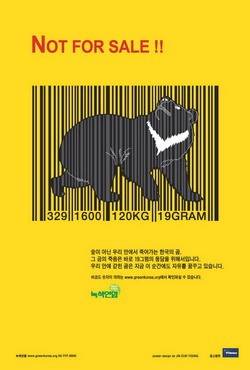 These bears are killed for oriental medicine, especially for their gall bladder but also for their meat and feet. Customers regularly visit the farms to select their own bear for slaughter.
A bear gall bladder sells for up to $20,000 in Korea. Mr. Kim, Muung- an ex Chairman of the Korean Bear Farms Union argues that deregulation will allow farmers to compete with imported bladders from China. China, Russia and North Korea have huge bear farming industries.
The Korean Union of Bear Farms insists that what is happening outside of Korea, namely a rising number of bans on endangered species, is not relevant to Korea as the bears are born in captivity.
However, the further liberalisation will only encourage Koreans to believe other wild animals can be killed for commercial use.
According to reports on oriental medicine there is over speculations about bear’s gall bladder being extra effective to cure human liver problem, it also can be replaced by over 100 other different herbal formulas.
It is clear that the number of bears killed in Korea exceeds what would be possible if regulations were being followed. Green Korea reports that 38% of oriental medicine shops in Korea [62 out of 163 shops visited] are secretly selling bear gall bladder and that when shops are generally asked whether they do so they respond with extreme caution.
According to a survey, the majority (87.1%) of Korean people do not agree with bear slaughter for use of gall bladders. And yet the trade continues..
There are legal processes set out for the establishment of bear farms and the sale of bear products. However these are clearly being ignored and not enforced. Advertisements for internet sales for bears and bear breeding are easily found in Korean internet shopping malls.
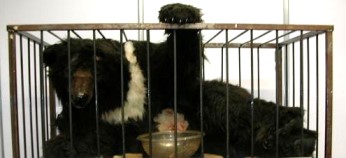
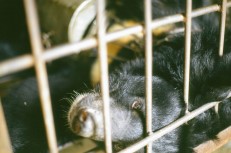 Visits to 10 bear farms by in 2004, hygiene standards and the condition of bears were both extremely poor. Most bears were in small dog cages – around 1 meter by 2 meters in size. There are frequently up to 10 bears in larger cages.
All bears were showing signs of abnormal behaviour. Some farms were located in the gardens of residential houses or temporary buildings. The "farmers" indicated that there were no inspections by authorities.
Just imagine many bears waiting to be slaughtered for their gall bladder, feet and meat, crowded into small and filthy cages being fed pigs food on a daily basis. In the West, activists protest against similar treatment of battery hens. Here we are talking about a protected species, and one of the world’s most magnificent animals. Nothing is being done by authorities to stop the trade in Korea.
The cruellest thing for this animal – remember this is the animal meant to be the mother of the Korean nation - is that they cannot live in the wild. Bears hibernate in their natural environment and the need to do this is indelibly implanted into their DNA. But bears caged at farms cannot hibernate during Korea’s bitterly cold winters. This drives them insane, and activists have seen bears self-harming themselves against hard objects in despair.
Article author: Mrs.G.Moon
